
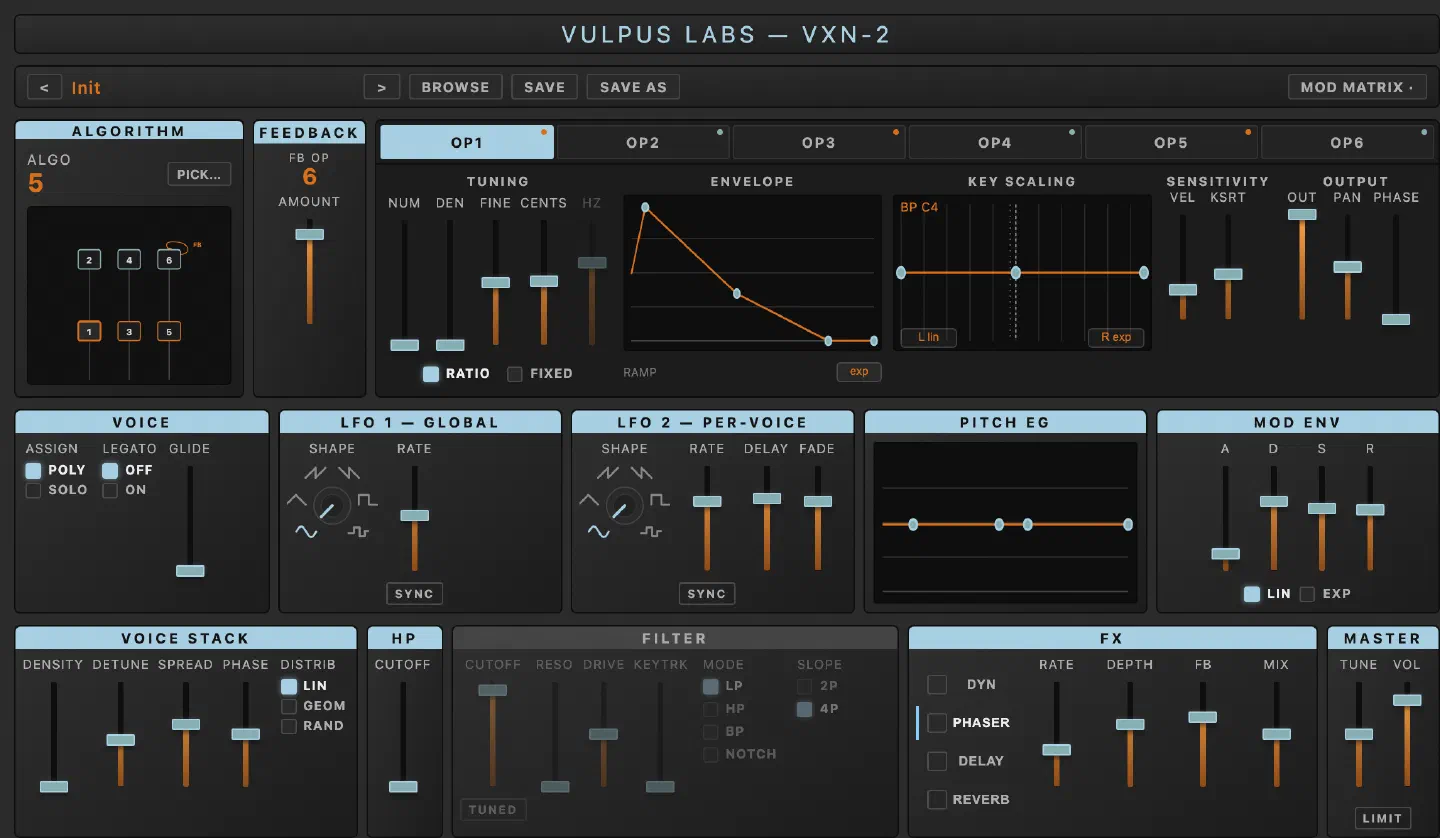
VXN2 (“vixen 2”) is a six-operator FM synthesizer, shipped as a CLAP and a VST3 plugin for macOS and Windows. Six sine oscillators, thirty-two ways of wiring them to each other, and a stacking engine that turns one note into eight.
FM is where the bells, electric pianos, glassy basses and metallic stabs come from — sounds that no amount of filtering will get you out of a sawtooth.
The voice
Six operators. Which ones you hear, and which ones bend the others, is set by the algorithm: thirty-two arrangements, changed with a single control, and changing it never disturbs the values you have dialled into the operators themselves. One operator in each arrangement feeds back into itself, running from a pure tone at zero up to noise at full.
Voice stacking
Play one note and hear up to eight.
Detune fans the lanes out by up to a hundred cents while the centre lane stays put, so a patch thickens without the pitch wandering off. Space the lanes evenly for a smooth chorus, cluster them to keep most of the stack close to the centre, or scatter them so no two notes come out quite alike.
Phase spread sets how the stack starts. Line the lanes up and the attack is hard and immediate. Push them apart and the note softens and shimmers into being.
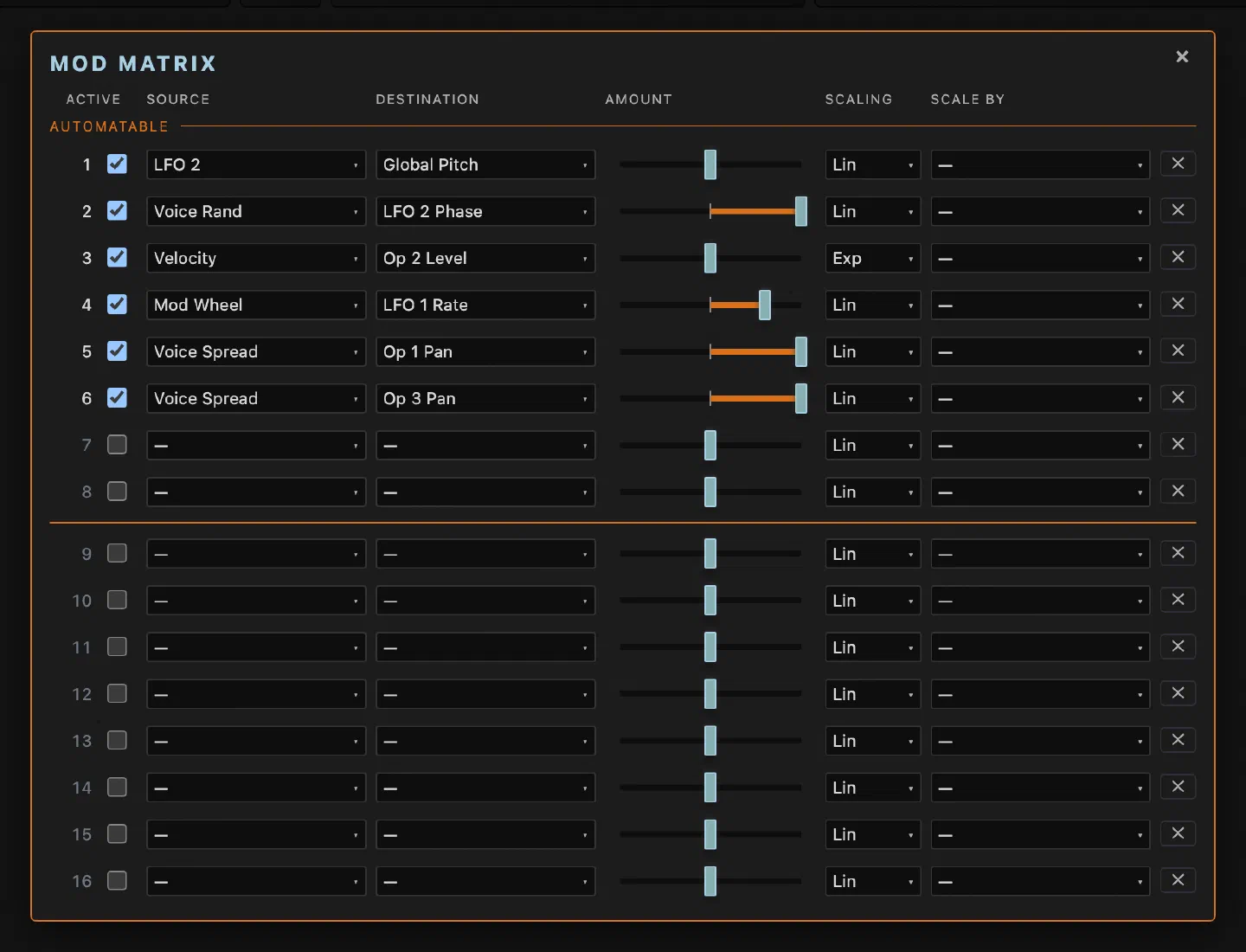
Spread is a modulation source in its own right, so what varies across the stack is yours to choose. Route it to pan and one note fills the stereo field. Route it to a modulator’s level and the stack grades from clean at its centre to biting at its edges — several timbres inside a single note. Route it to an operator’s pitch and the outer lanes drift into inharmonic territory while the core stays sweet.
Per-operator control
Every operator has its own four-stage envelope, so an FM sound evolves rather than sits — the modulators can fade in behind a carrier, or bite hard on the attack and vanish. Tuning is by ratio, with just intervals and a continuous fine offset for ratios that never quite repeat, or Fixed mode for the absolute frequencies that give you bells, mallets and struck metal. Velocity sensitivity and keyboard scaling keep a patch even from the bottom of the keyboard to the top.
Modulation
Two LFOs — one shared across the patch and tempo-syncable, one per voice with delay and fade-in for the breathy, humanising kind of movement. A pitch envelope that can swing up or down into a note. A spare envelope with no fixed job. All of it lands in a sixteen-slot matrix that reaches per-operator pitch, level and pan, the filter, the stack macros and the effects, through linear, exponential, logarithmic or bipolar curves.
Filter and effects
An oversampled ladder sits after the stack, off by default and out of the signal path entirely when it is: low-pass through notch, 12 or 24 dB/octave, drive on the way in and self-oscillation at full resonance, for when you want FM to sit behind something subtractive. After it, dynamics, phaser, delay and reverb — the compressor first, so it evens out FM’s sharp transients before the time effects get hold of them.
Voicing
Up to sixteen voices, or Solo with legato and portamento.
Install
Unpack the archive and copy the plugin into the matching directory, then rescan plugins in your DAW.
CLAP (VXN2.clap) | VST3 (VXN2.vst3) | |
|---|---|---|
| macOS | ~/Library/Audio/Plug-Ins/CLAP/ | ~/Library/Audio/Plug-Ins/VST3/ |
| Windows | C:\Program Files\Common Files\CLAP\ | C:\Program Files\Common Files\VST3\ |
The Windows CLAP download is the bare .clap file — copy it straight in. Every
other download is a zip archive.