
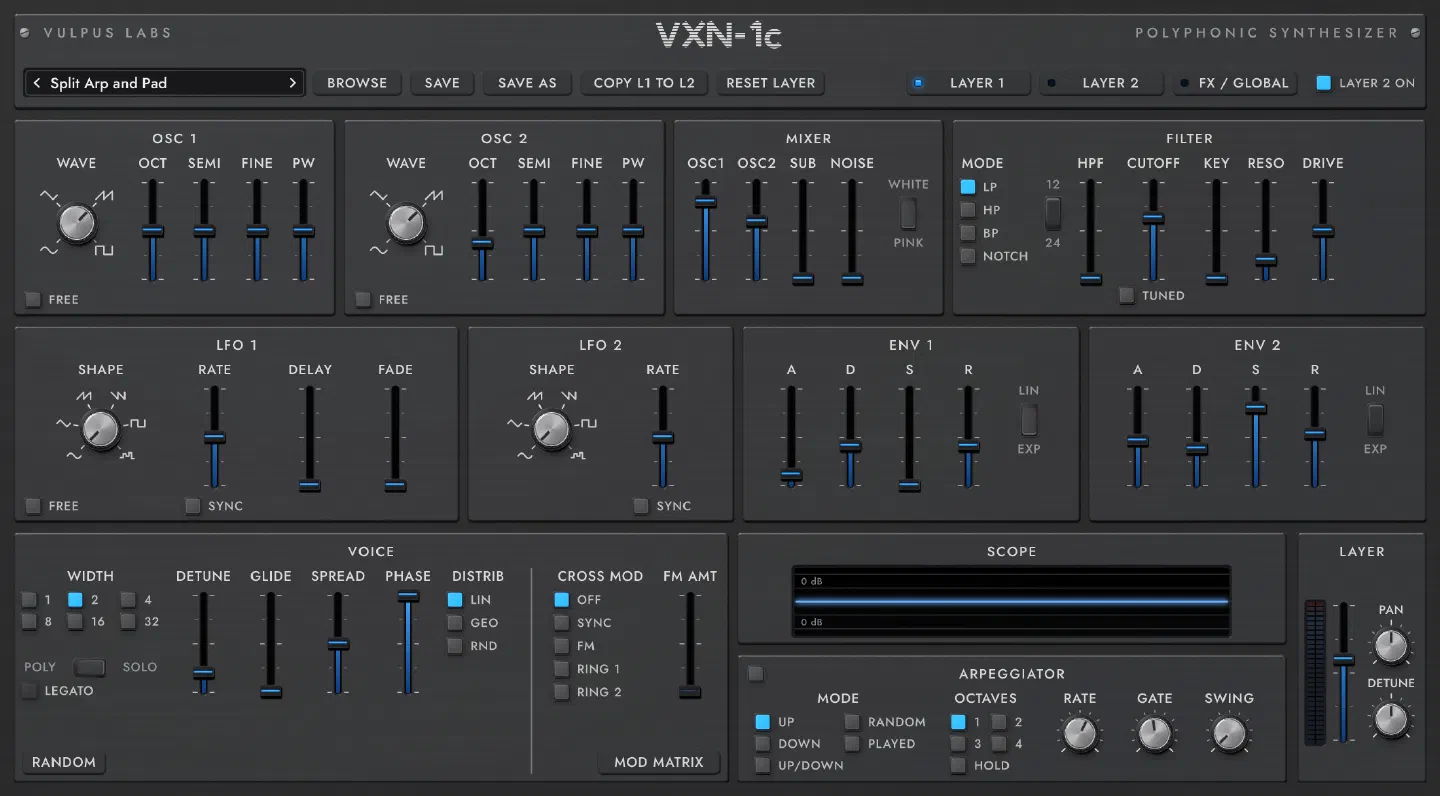
vxn-1c is a dual-layer subtractive polysynth and the successor to VXN1b. It plays VXN1b’s sounds through a new faceplate, with a new chorus, cleaner oscillators and filter, an arpeggiator on each layer, and a RANDOM button that builds a new sound in one of eleven styles. It is coming as a CLAP plugin for macOS and Windows, with VST3 to follow, and you can play it now in your browser: the web build is the same engine and the same faceplate, compiled to WebAssembly.
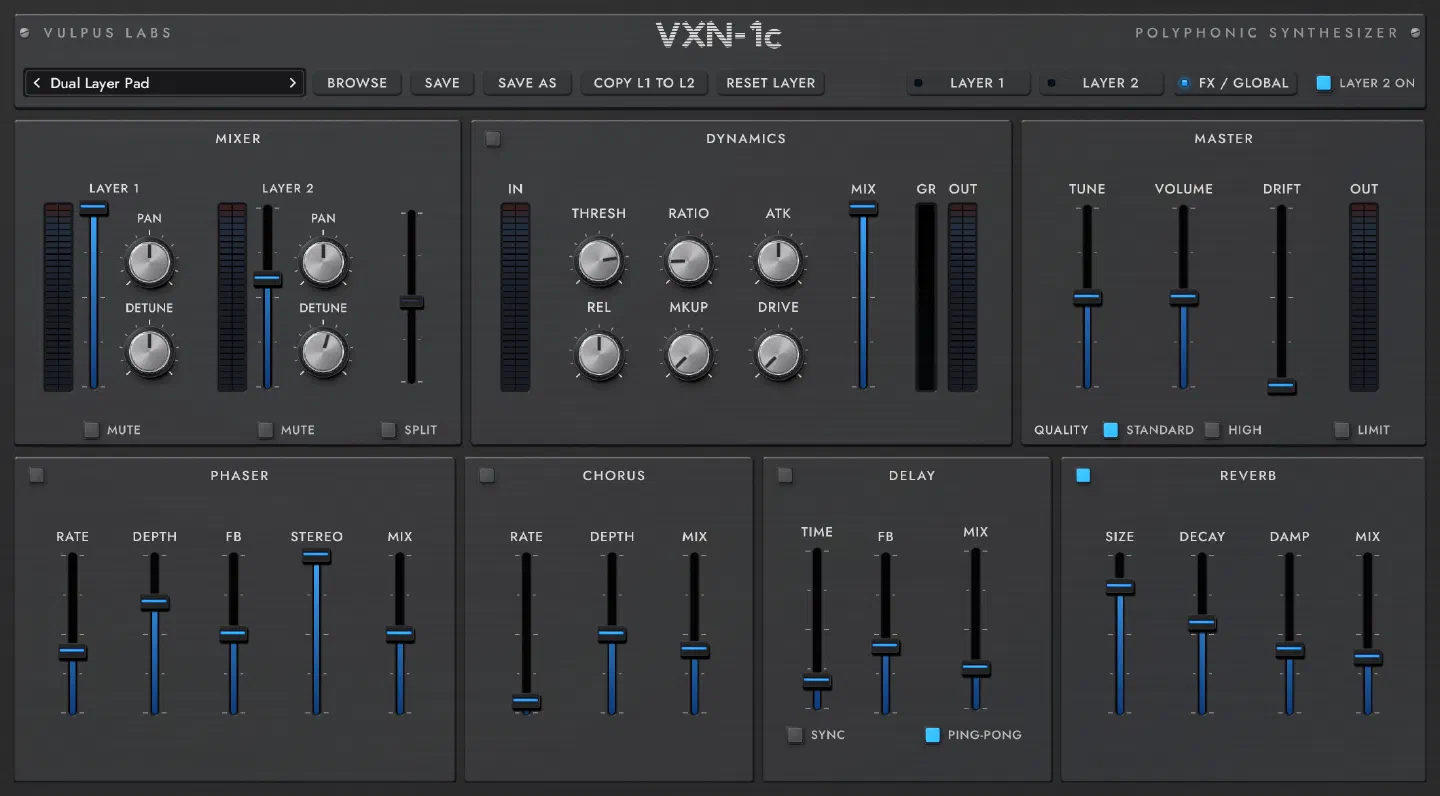
A patch is two complete instruments, Layer 1 and Layer 2, sharing one set of effects. Layer 2 doubles Layer 1 on every note or takes the keys below a split point — a pad under a lead, a bass under an arpeggio, or a sound thickened by a detuned copy of itself.
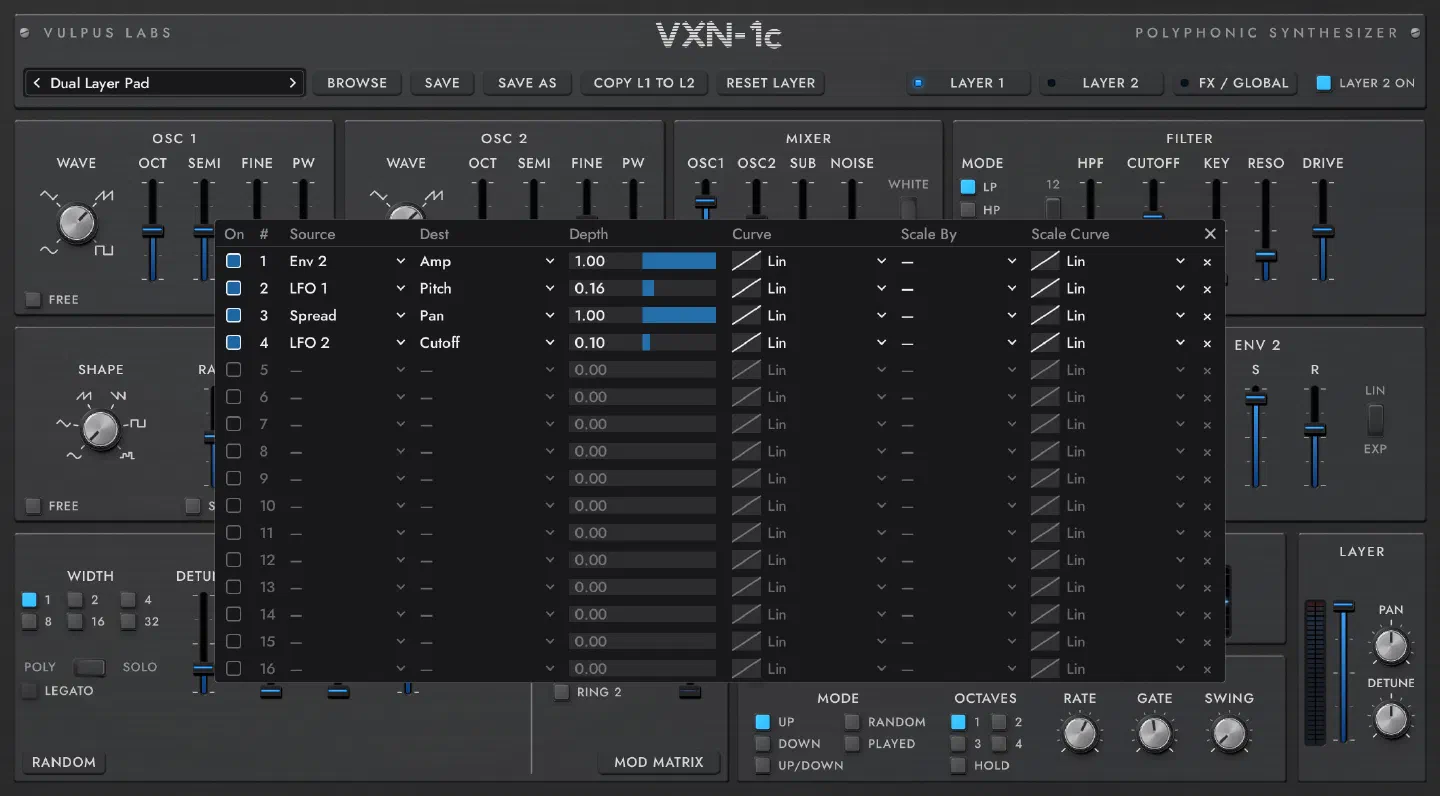
No modulation route is hard-wired: every modulatable parameter is assignable from every modulation source.
The voice
- Oscillators. Two, with variable pulse width, plus a sub and a noise source. Hard sync, FM and two kinds of ring modulation are available as cross-modulation modes between the pair.
- Filter. A 4-pole zero-delay ladder — low-pass, high-pass, band-pass or notch, 12 or 24 dB/octave — with drive and self-oscillating resonance. A gentle high-pass on each layer’s sum keeps its low end in check.
- Envelopes and LFOs. Two ADSRs, linear or exponential, and two LFOs per layer; LFO 1 has a delayed fade-in.
- Arpeggiator. One per layer, so a split can arpeggiate one side and hold the other: up, down, up/down, random or as played, over one to four octaves, synced to the host’s tempo, with gate, swing and hold.
Voice stacking
Each layer is 32-note polyphonic, or stacks voices: 16 doubled, 8 quadrupled, and so on to all 32 in unison on one note.
Within a stack, voices are detuned and phased, fanning them out in pitch and start phase, spaced evenly, geometrically or at random. A routable spread source can be applied to anything a voice has, from pan to pulse width or cross-modulation depth.
The modulation matrix
Sixteen slots per layer, each routing a source through a depth and a curve to a destination, optionally scaled by a second source: envelopes, LFOs, velocity, key, the wheels, aftertouch, a per-note random value and a stack’s spread and position, into pitch, pulse width, cross modulation, cutoff and resonance, amplitude, pan, LFO 1’s rate and the envelopes’ times and sustain.
Effects
Dynamics, a bucket-brigade chorus, phaser, tempo-syncable delay and reverb, then a limiter. QUALITY sets how far the voices are oversampled: Standard for everyday playing, High for the cleanest top end.
Presets
A factory bank of over fifty presets, including VXN1b’s converted bank and the manual’s worked examples. The manual describes every control, with graphs measured from the synth’s own code.