
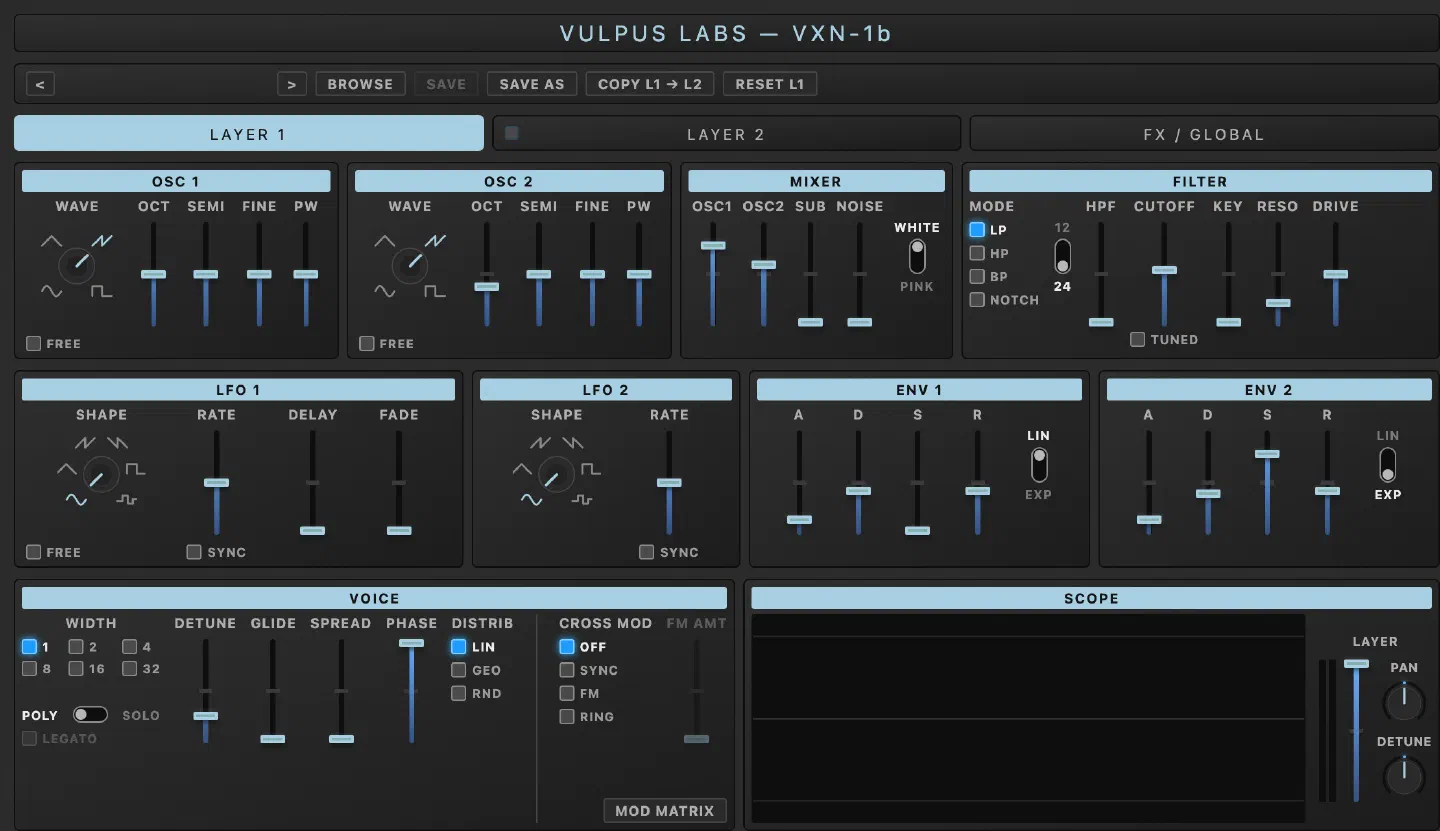
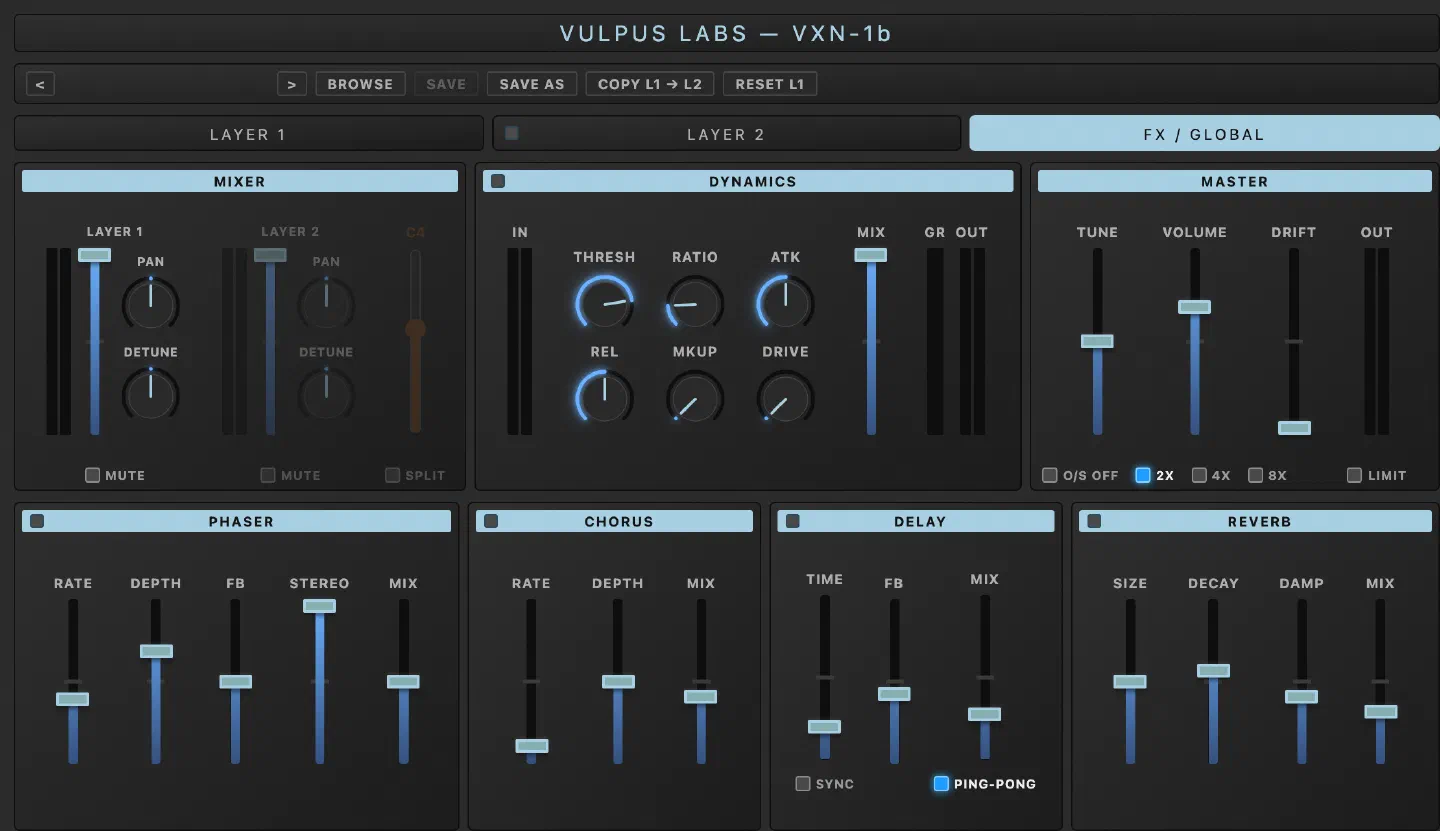
VXN1b is a dual-layer subtractive polysynth, shipped as a CLAP and a VST3 plugin for macOS and Windows. A patch is two independent layers, each with its own voice and 16-slot modulation matrix. Place a pad under a lead, or thicken a sound with a detuned copy of itself.
No modulation route is hard-wired: every modulatable parameter is assignable from every modulation source.
The voice
- Oscillators. Two, with variable pulse width, plus a sub and a noise source. Hard sync, phase modulation and ring modulation are available as cross-modulation modes between the pair.
- Filter. A 4-pole ZDF ladder capable of overdrive and self-oscillating resonance.
- Envelopes and LFOs. Two ADSRs and two LFOs per layer.
- Effects. A bucket-brigade chorus, phaser, delay, reverb and dynamics.
Voice stacking
By default, each layer is 32-note polyphonic. But you can choose to stack voices: 16 doubled, 8 quadrupled, and so on all the way to having all 32 notes playing in unison at once.
Within the stack, voices can be detuned and phased, fanning them out in pitch and start phase. There is also a routable “spread” modulation source which can be applied to any attribute the voice possesses, from pan to pulse width or cross-modulation depth.
Install
Unpack the archive and copy the plugin into the matching directory, then rescan plugins in your DAW.
CLAP (vxn1b.clap) | VST3 (VXN1b.vst3) | |
|---|---|---|
| macOS | ~/Library/Audio/Plug-Ins/CLAP/ | ~/Library/Audio/Plug-Ins/VST3/ |
| Windows | C:\Program Files\Common Files\CLAP\ | C:\Program Files\Common Files\VST3\ |
The Windows CLAP download is the bare .clap file — copy it straight in. Every
other download is a zip archive.