
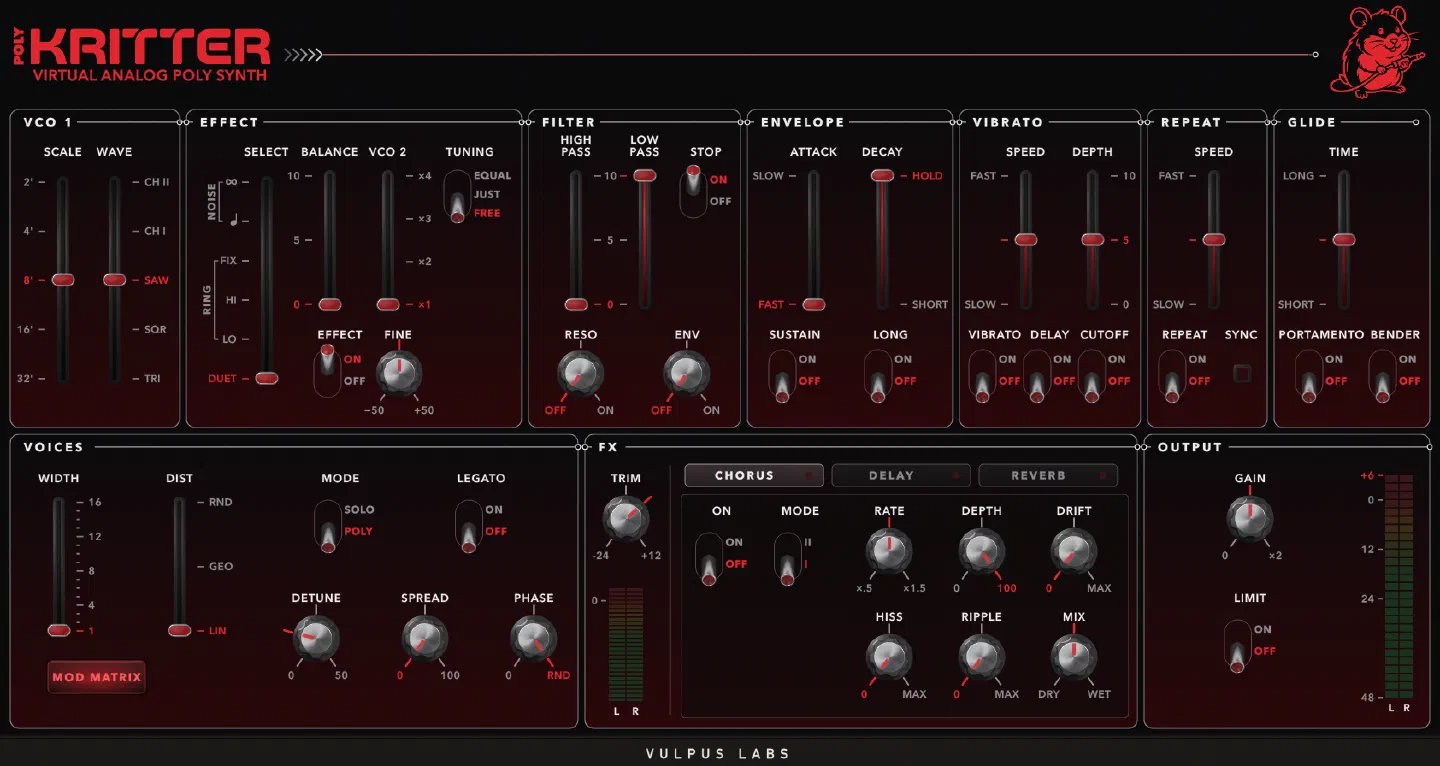
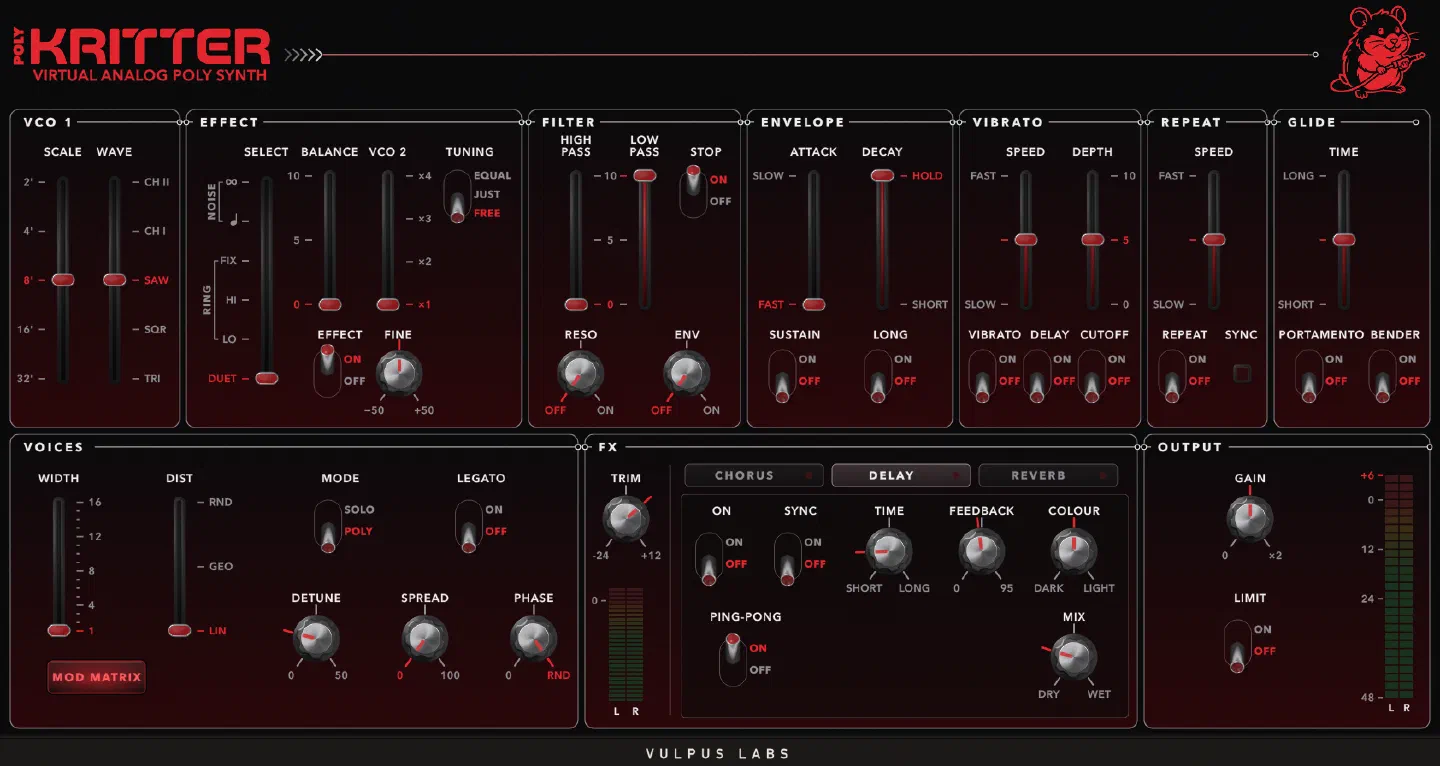
PolyKritter is Kritter, the Vulpus Labs virtual analog monosynth, played polyphonically. Each voice is a whole Kritter voice, and every voice shares one panel: each control is where it is on Kritter, does what it does there, and starts where it starts there.
It is in development as a CLAP plugin, and you can play it now in your browser: the web demo is the same engine and the same faceplate, compiled to WebAssembly. Play it from the on-screen keyboard, from your computer keys (A to ’ for the notes, Z and X for the octave), or from a MIDI controller. It works best in Chrome, Edge or Firefox; Safari is not supported.
The voice
- Oscillators. VCO 1 is one oscillator with a divider chain beneath it: five waves at five footages, all phase-locked. VCO 2, the effect section’s own oscillator, tracks VCO 1 at one to four times its pitch, tuned FREE, JUST or EQUAL, with FINE.
- The effect section. SELECT sets it to noise, a ring modulator (FIX, HI or LO) or DUET, and BALANCE sets VCO 1 against it.
- Filters. A high-pass and a low-pass diode filter, with resonance, envelope and vibrato on the cutoff.
- Envelope, vibrato, repeat and glide. Kritter’s envelope with SUSTAIN and LONG, a vibrato with delayed fade-in, REPEAT to re-strike held notes from one shared clock, and portamento with the Bender’s swoop.
Voices and stacking
PolyKritter keeps a pool of twenty voices, sixteen of them sounding at once. The VOICES strip decides how they are dealt out:
- WIDTH stacks from one to sixteen voices on every note.
- DETUNE, SPREAD and PHASE fan a stack out in pitch, in pan (or wherever SPREAD is routed), and in start phase; DIST spreads them linearly, geometrically or at random.
- SOLO plays one note at a time. With LEGATO on, a new note slides the voices to it without a new strike.
A voice that has gone silent stops running, so PolyKritter costs most while every voice is sounding and little while it waits.
The mod matrix
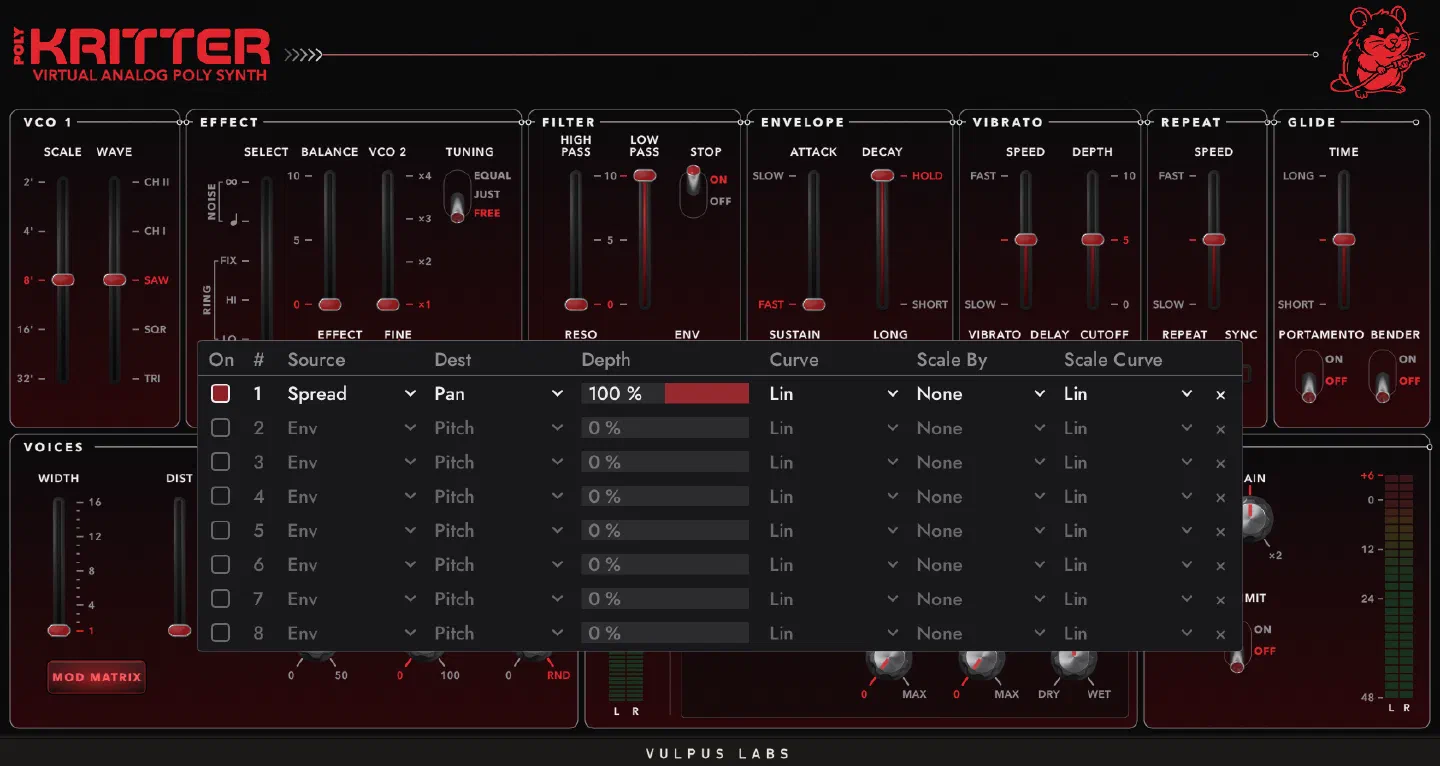
Eight slots, each routing a source to a destination through a depth, a curve and an optional scaling source:
- Sources: the envelope, the LFO, velocity, key, the mod wheel, aftertouch, a per-note random value, a stack’s spread and position, the gate, the voice’s index, and the delayed vibrato’s fade-in.
- Destinations: pitch, VCO 2’s pitch, BALANCE, the low-pass and high-pass filters, cutoff, resonance, amplitude, pan, and the envelope’s attack, decay and length.
Effects
- Chorus. A bucket-brigade chorus with two modes, and its hiss, drift and ripple, each from none to full.
- Delay. A stereo delay, ping-pong by default, free or synced to the tempo. Its COLOUR tilts the repeats darker or lighter as they feed back.
- Reverb. An eight-line feedback delay network, with a low cut on its input.
- Output. A lookahead limiter after GAIN, and a scope and meters across the top and side of the panel.