
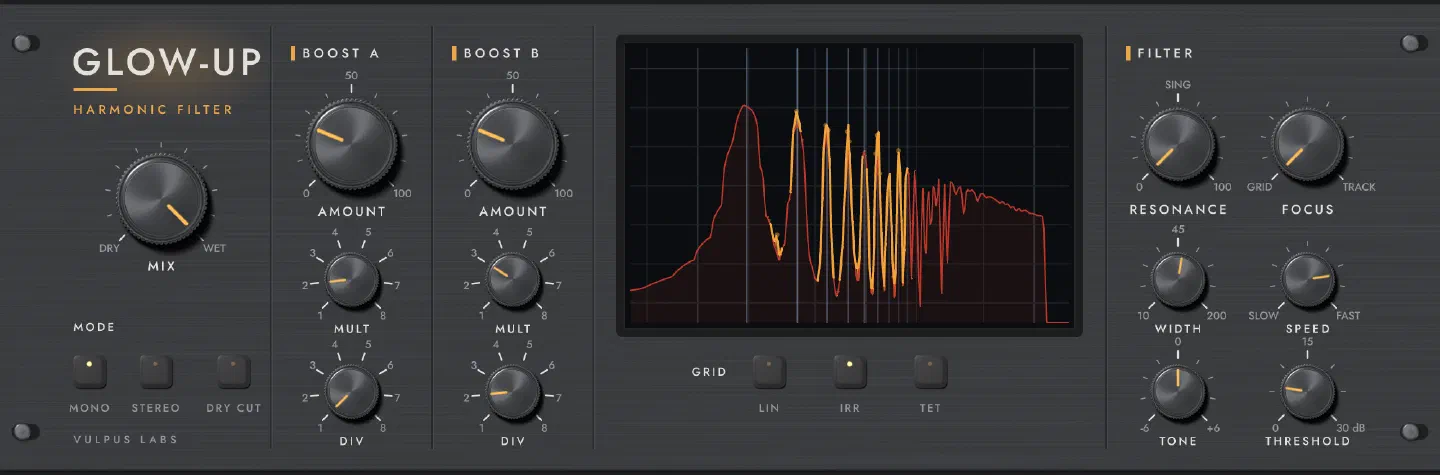
Glow-Up listens for the strongest notes and overtones in a sound and brightens it at chosen intervals above them: an octave, a fifth, or any ratio you set. It does this with narrow filters that lift what is already there, so it adds shimmer and focus without adding notes, until you turn up its resonance and the filters start to sing. It is a free CLAP and VST3 plugin for macOS, Windows and Linux (downloads), and its source is on GitHub under the MIT or Apache-2.0 licence.
The boosts
Glow-Up has two boosts, A and B. Each has an AMOUNT and a ratio set as MULT over DIV, each from 1 to 8: A starts at 2/1, an octave up, and B at 3/2, a fifth up. Ratios that land on a note’s overtones, such as 2/1, 3/2, 3/1 and 4/1, are where the effect is strongest; a ratio below 1, such as 1/2, boosts below each peak, where there is something there to boost.
The filters
FOCUS decides where the filters sit. At GRID they stay on fixed pitches, and a bend or slide sweeps through them, swelling as it passes, like the resonances of a body or a room; the GRID keys pick an even (LIN), irregular (IRR) or equal-tempered (TET) grid. At TRACK each filter follows its target exactly, through bends and vibrato. RESONANCE sharpens the boosts until, past its SING mark, strong notes make their filters sing. WIDTH, SPEED, TONE and THRESHOLD set how narrow the boosts are, how fast they react, whether they favour low or high pitches, and how strong a pitch must be to get one.
The screen
The screen shows the input in red and the output in amber, with the glow between them where the boosts land, the pitches found as vertical lines, and each filter as a dot.
Output
MIX blends the effect with the clean sound, and DRY CUT leaves only the boosts. MONO, the default, takes the left input to both outputs; STEREO boosts each side. Glow-Up adds no latency, so it can sit on a live input.