
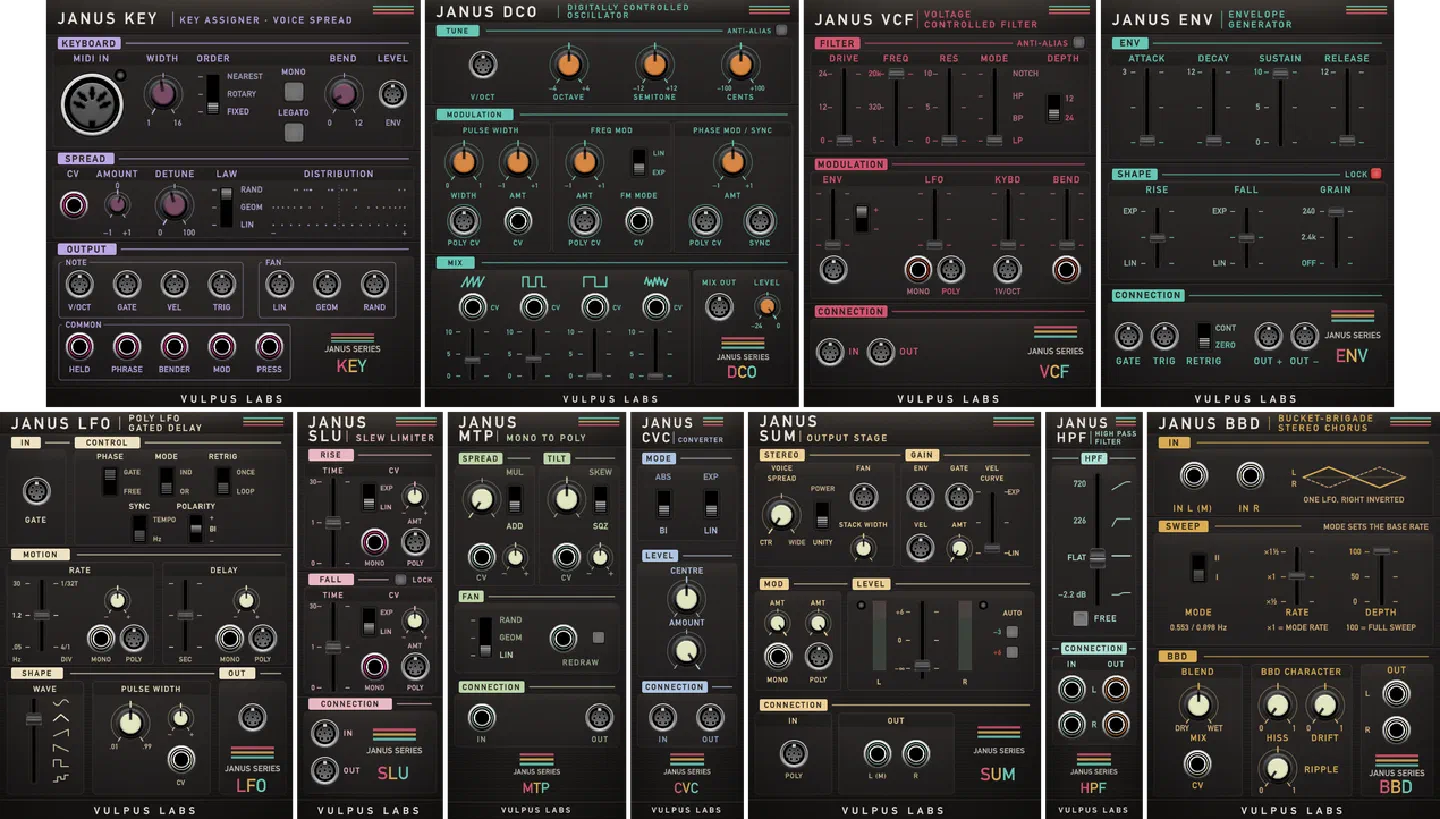
The manual covers:
- what the series is for: voices grouped into stacks, with pitch, brightness, stereo position, modulation rate and timing spread across each stack by an amount you set;
- a chapter for each module, with a labelled view of its panel and every control and jack;
- KEY’s stacks, its three spread laws, voice stealing and the LEVEL input;
- MTP and CVC, which turn one signal into a value per voice and reshape a spread;
- DCO’s waveforms, mix and anti-aliasing, and VCF’s drive, resonance and four modes;
- ENV’s stages, curves and GRAIN, LFO’s gated delay and restarts, and SLU’s glides;
- SUM’s VCA, stereo spread and AUTO level, HPF’s positions, and BBD’s sweep, hiss, drift and ripple;
- six patches, building on one classic voice, most drawn as the modules’ panels with their cables;
- two appendices on how BBD and DCO are built.